- Platform
- Platform Overview
- Life science compliance
- Enterprise-grade security
- Integrations
- Partner Ecosystem
- Workflow management
- Claims & evidence management
- Digital asset management
- Web annotation
- Health authority submission support
- Portals
- Cross channel publishing
- Global commercialization
- Vodori 360
- Reporting & analytics
- Solutions
- Resources
- Company
- Trust
Streamline & accelerate with enterprise content management software
Bring content review, approval, and distribution into one governed system built for the complexity of enterprise life sciences. Connect the tools your teams already use, standardize processes across business units and markets, and scale with greater control, visibility, and cost predictability.
Platform Overview
Designed with enterprise goals in mind
Configurable workflows
Create distinct workflows for different content types, business units, geographies, or partner organizations. Have total control over which teams have access to various workflows and what content they’re able to access in the library.
- Parallel and sequential workflows
- Permissions-based content access
- Rules-based reviewer assignments
Built-in Compliance
Pre-approve individual claims, add supporting documentation, and capture audit trails for every piece of content routed for review. Your regulatory and legal teams can rest easy that you’re maintaining process compliance and are fully prepared should you be audited.
- Downloadable audit trail
- e-Signature in compliance with 21 CFR Pt 11 & EU Annex 11
- Version comparison
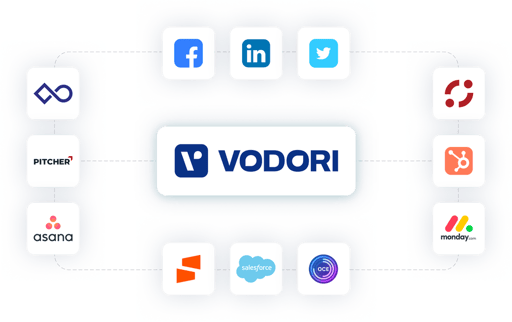
Native Salesforce integration, plus an open API
Vodori is Salesforce’s only MLR partner delivering approved materials into Salesforce AgentForce Life Sciences, Sales, and Service Clouds, so reps and field teams only ever see the latest approved content. Beyond Salesforce, upstream and downstream integrations cover DAMs, CRMs, and publishing platforms, with an open API for everything else.
- Salesforce Life Sciences, Sales, and Service Clouds
- Upstream and downstream DAM and CRM integrations
- Open API for existing systems
Globalized & Localized Content
Localized and translated versions are difficult to keep track of at global scale. Vodori manages global, local, and translated content in one place and routes each through the appropriate workflow before approval. When something changes, you can expire outdated content and notify affiliates that updates are required.
- Parent/child content relationships
- Revision-based workflows
- Centralized content library
Which MLR metrics are worth tracking?
Five metrics carry most of the signal: job duration, review duration, circulations per asset, days spent incorporating feedback, and first-circulation approval rate. Self-service dashboards surface the metrics that mean the most to your organization, and Vodori publishes annual benchmarks so you can set your numbers against industry data rather than guessing.
- Self-service reporting dashboards
- Review time data by team and role
- Downloadable data extracts
Configurable workflows
Create distinct workflows for different content types, business units, geographies, or partner organizations. Have total control over which teams have access to various workflows and what content they’re able to access in the library.
- Parallel and sequential workflows
- Permissions-based content access
- Rules-based reviewer assignments
Built-in Compliance
Pre-approve individual claims, add supporting documentation, and capture audit trails for every piece of content routed for review. Your regulatory and legal teams can rest easy that you’re maintaining process compliance and are fully prepared should you be audited.
- Downloadable audit trail
- e-Signature in compliance with 21 CFR Pt 11 & EU Annex 11
- Version comparison
Native Salesforce integration, plus an open API
Vodori is Salesforce’s only MLR partner delivering approved materials into Salesforce AgentForce Life Sciences, Sales, and Service Clouds, so reps and field teams only ever see the latest approved content. Beyond Salesforce, upstream and downstream integrations cover DAMs, CRMs, and publishing platforms, with an open API for everything else.
- Salesforce Life Sciences, Sales, and Service Clouds
- Upstream and downstream DAM and CRM integrations
- Open API for existing systems
Globalized & Localized Content
Localized and translated versions are difficult to keep track of at global scale. Vodori manages global, local, and translated content in one place and routes each through the appropriate workflow before approval. When something changes, you can expire outdated content and notify affiliates that updates are required.
- Parent/child content relationships
- Revision-based workflows
- Centralized content library
Which MLR metrics are worth tracking?
Five metrics carry most of the signal: job duration, review duration, circulations per asset, days spent incorporating feedback, and first-circulation approval rate. Self-service dashboards surface the metrics that mean the most to your organization, and Vodori publishes annual benchmarks so you can set your numbers against industry data rather than guessing.
- Self-service reporting dashboards
- Review time data by team and role
- Downloadable data extracts

Enterprise-ready security
We know that your business requires you to maintain security with respect to company and customer data and for purposes of your compliance with applicable laws. Vodori’s rigorous compliance program focuses on data security, SDLC and infrastructure, risk management, and how we select and assess our vendors.
Learn MoreFrequently Asked Questions
What is the actual total cost of ownership of switching from Veeva?
Hidden costs can erode the return on your software investment over time. Understanding total cost of ownership is important to understand all costs associated with a promotional review system. Consider how much training you’ll require, configuration changes, end user support, and if the software requires any certifications to use the software. Specifically, track differences between licensing fees, implementation services, end user support, configuration changes, ongoing training, and upgrade management when comparing Veeva and Vodori. To help build your business case, Vodori's ROI calculator lets teams model their own before-and-after costs.

What MLR benchmarks should commercial operations leaders track?
The core MLR metrics to track are job duration (end-to-end time to approve content), review duration (time reviewers take to give feedback), number of circulations per asset, days spent incorporating feedback, and first-circulation approval rate. Vodori publishes these annually in its State of Promotional Review benchmarks, so teams can compare their performance against industry data.
Which MLR vendors integrate natively with Salesforce?
Turnkey Salesforce integration matters because it delivers approved content directly into the systems field and commercial teams already use. Vodori is Salesforce’s only MLR partner that delivers approved materials intoSalesforce AgentForce Life Sciences, Sales, and Service Clouds, so only the latest content is in use by reps and field teams.
Which promotional review tools integrate with existing CRM and DAM systems?
Enterprise teams benefit from using anMLR platform with an open integration ecosystem so it fits within the existing, preferred tech stack. Vodori offers an open ecosystem with both upstream and downstream integration options spanning DAMs, CRMs, publishing platforms, and more, which keeps approved content flowing between systems without duplicate work.
Which MLR platforms support content reuse and global-to-local adaptation?
Global enterprises create a lot of great content but without the appropriate traceability, it is difficult to keep track of the localized and translated versions of that content. Vodori provides organized management of global, local, and translated content and ensures it goes through the appropriate workflows before being approved. When content changes, Vodori makes it fast and easy to expire outdated content or notify affiliates that content updates are required. Additionally, users have access to browse content created by other regions as a starting point for their content.